Just Because I Can: The Great Capability Multiplier
Exploring how AI transforms development from months-long marathons into days-long sprints, enabling individual creators to tackle previously impractical projects.
What AI Enables: The Great Capability Multiplier
I. Capability Multiplier
I retired from the corporate world in June of last year, and while I certainly miss that steady paycheck, I enjoy having the time for doing things that were difficult with a full time job. This blog, Silver Pixels and Suitcases (SPAs?) is my attempt to share some of my interests, what I am learning with and about AI on the technical front, as well as the impact of Digital Life on silver-haired people. And hopefully, some pictures of our travels.
As I advanced in my product development career and took on greater responsibility, I realized that I needed to continually develop new skills to avoid falling victim to the ‘Peter Principle’[1] . At the same time, I began losing my hands-on ability to write production-quality software. Although I stayed current with new technologies, I was no longer able to produce code at a level I once considered acceptable.
It’s a topic I read about almost every day: ‘vibe coding’—that intuitive flow where you describe what you want and AI helps bring it to life. For me, AI has been a massive capability booster. It has fundamentally transformed development from what would have been a months-long marathon into a days-long sprint, amplifying my existing skills in ways that feel almost magical.

The folk culture of software development talks about the mythical 10X programmer [2][3][4]. I speculate that AI has transformed my capabilities from perhaps a 0.5X programmer to may be a 5X programmer. I am not deluded; the former 10X programmers can now be 100X as their deeper knowledge of the core technologies is an even bigger multiplier, and the bar for writing good quality production code has also risen.
Since I am no longer looking for a job, I could be candid and say that I enjoy building stuff. In retrospective, I could envision former bosses interviewing me now for a CTO position; I could anticipate a range of reactions on hiring a leader that likes to stay close to the technology. We will explore, in part 3 of this series, the implications of #justbecauseican in the corporate product development world.
For now, let me postulate that if you are a technology leader in product management, product development, QA, DevOps, security, it's imperative that you get a good understanding, even hands-on with these new AI tools. Or you'll be looking at early retirement or an entertaining job in the gig economy.
Example 1: This Blog Platform
This very blog illustrates the point. Yes, I'm aware that WordPress, Ghost, and countless other content management systems exist. But I wanted something different – something simpler, more tailored to my specific needs, and something that would keep me learning about the latest technologies.
Building a custom blog platform from scratch would traditionally involve weeks of architecting the database, designing the UI, implementing authentication, creating admin interfaces, setting up deployment pipelines, and countless other technical tasks. With AI as my development partner, I was able to:
- Design and implement a clean, minimal interface - 2 days.
- Generate ~60% of the content through AI assistance, allowing me to focus on the unique insights and personal experiences.
- Create 100% of the images using AI generation, eliminating the need for stock photos or graphic design skills.
- Rapidly iterate on features and styling without really having to code, just directing in english.
- Do both code and content development within my IDE, in what it is a virtous cycle of thinking and doing.
BTW, there are a few mistakes on the generated images, which I leave as an exercise for the reader to identify.
The result is a platform that's perfectly suited to my needs while serving as a continuous learning laboratory for new technologies. Would I recommend this approach on a corporate job? NO. But if you don't know what's possible, you wouldn't be able to select a good vendor or push them to the realm of the possible.
Example 2: The Plans4Trips Application
The Plans4Trips project (www.plans4trips.com) represents an even more ambitious example of AI-enabled development. This application tackles the particular challenge of travel planning for groups of friends or families. In my particular case, for my family of 3 children, 5 grandchildren, living in 3 different cities, with diverse interests in activities, planning a joint Christmas or Easter vacation is a logistical nightmare. Excel was impossible and the tens of commercial travel applications pushing you towards tours, hotels, attractions, popups, etc. was exasperating.
So #justbecauseican, I created Plans4Trips, to help us solve our traveling planning and logistics. See for example the itinerary comparison page for our upcoming Christmas vacation. This is an even more dramatic example of amplication, where I, a 0X designer, was able to use AI to develop a decent interface. Comments on the logo are welcomed, but a nicely designed professional logo would be greatly appreciated 😃
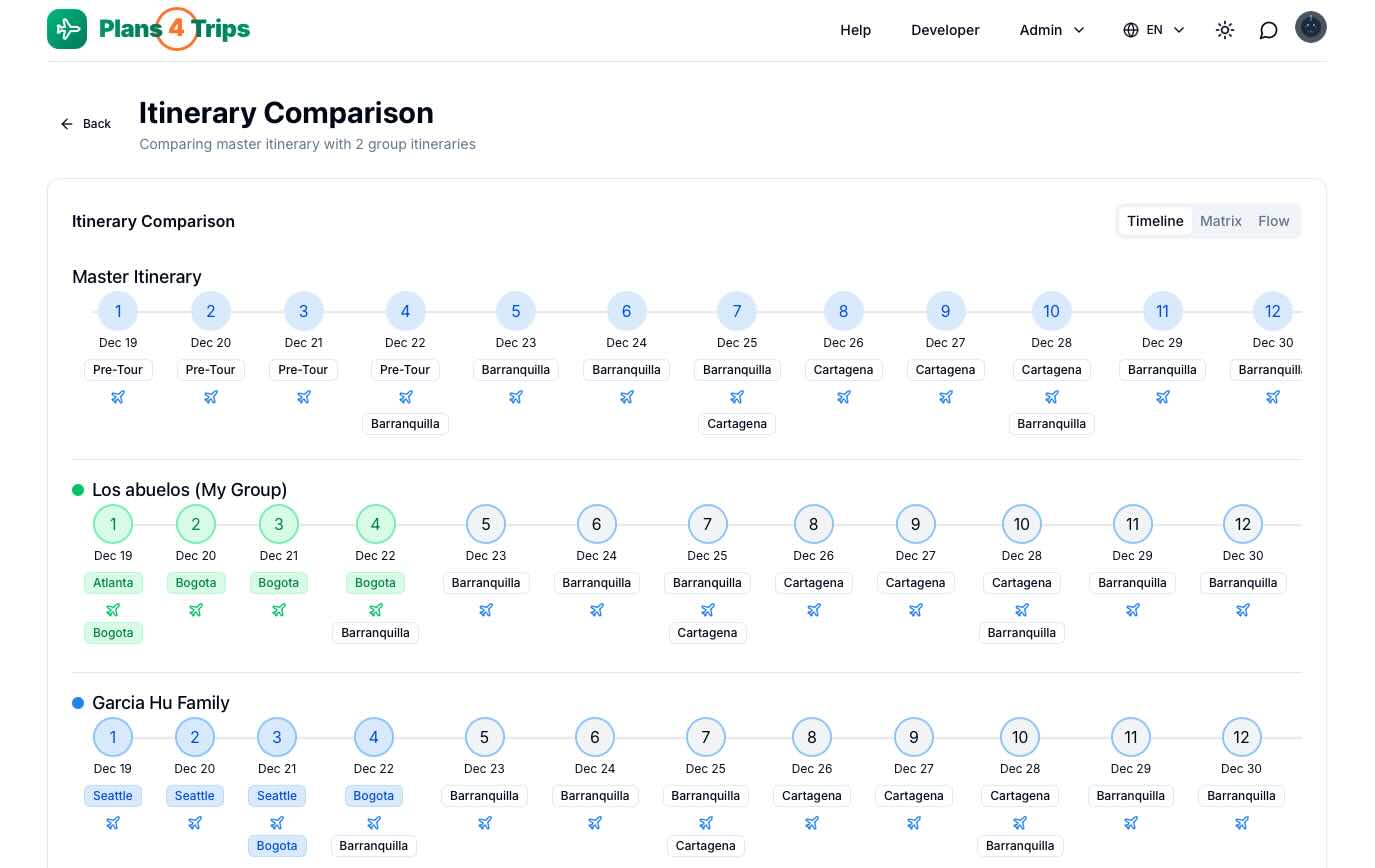
As another example, many years ago, it took us months to internationalize a suite of banking applications. I was able to retrofit the original English plans4trips site to support 4 languages: English, Spanish, French and Italian.
Without AI assistance, building such a platform would have been unrealistic for me. Most of the code was developed by writing instructions for Cursor to generate TypeScript, SQL, CSS, Tailwind, a Next.js front end, and the API with supabase as the database.
The scope would be daunting enough to discourage me. But with AI as a force multiplier, I was able to:
- Rapidly prototype and test different architectural approaches
- Generate the API layer and the postman tests
- Iterate on user interface designs with immediate feedback
- Handle complex business logic with AI-assisted problem-solving
- Create and MCP server for loyalty programs
- Translate content to several languages
The platform demonstrates how AI doesn't just speed up development – it makes previously impractical projects suddenly feasible for individual creators.
This is a family and friends site as I am aware of the immense effort that it would take to make it commercial. It is a good learning lab for me.
In the following posts of this series I will discuss the technology stack and tools that I am using, always looking for your feedback, for sharing your own experiences, for emerging organizational constructs, and for ideas on how to better amplify product development, #justbecausewecan.
Citations
- [1] Peter, Laurence J., and Raymond Hull. The Peter Principle: Why Things Always Go Wrong. New York: William Morrow, 1969. Harper Collins - The Peter Principle
- [2] The mythical 10x programmer - https://antirez.com/news/112
- [3] The 10x Programmer Myth - Simple Thread https://www.simplethread.com/the-10x-programmer-myth/
- [4] Stop saying 10x developer : r/programming - Reddit https://www.reddit.com/r/programming/comments/wxcupm/stop_saying_10x_developer/
This post explores the transformative impact of AI on development workflows and personal capabilities. It's part of my ongoing exploration of how emerging technologies are reshaping what's possible for individual creators and enterprises alike.